


We transport animals both in the cabin and in the luggage compartment.
Transportation of an animal or bird always requires preparation and compliance with the rules, so we recommend that you carefully study this section.
Please inform us that you are traveling with a pet no later than 48 hours before the flight departure. If you arrange transportation on our website, then fill out the application for approval.
If you arrange transportation at a call center or a third-party agency, then inform the agent about the need to transport the animal
Check out animal transportation rules and pay for the service at the departure airport before the flight departs, or when arranging transportation at the agency.
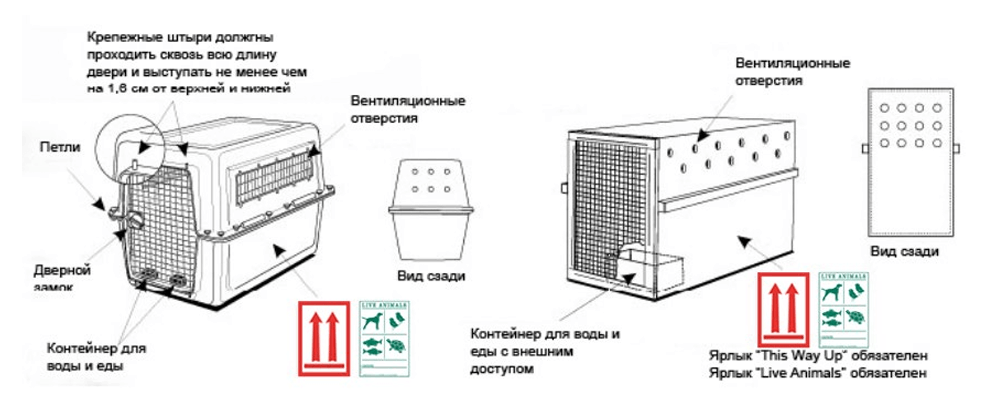
Place the pet in a cage/carrier.
Without a cage/carrier, we will not be able to put your pet on the flight. The exception is the guide dog and the service dog that flies in the cabin.
Confirm that the pet is healthy.
Show the animal's veterinary passport at the check-in desk at the departure airport so that we can make sure that your pet is OK
Accompany your pet.
The passenger who is transporting the animal must be listed as its owner and be of legal age.
The total weight of the animal/bird and the container/cage is not included in the free baggage allowance of the passenger:
|
Guide dog
|
Free
|
|
Animal up to 8 kg
with cage dimensions of no more than 115 cm in the sum of three dimensions (length+height+width); service code 0MN |
2 800 rub
(to 19.08.2026) 3 500 rub (from 20.08.2026) |
|
Service animal
service code AA1 |
5 000 rub
|
If the weight of the animal together with the container exceeds 8 kg or the carrying dimensions exceed 115 cm in the sum of three dimensions (length + height + width), then transportation is carried out only in the luggage compartment.
When registering the transportation of an animal traveling with a passenger on a non-direct flight (according to the route fare), a fee is charged for each section of transportation.
If the service has not been used, the cost of the service is fully refundable. To receive a refund, you must contact the place of purchase of the service.
If the service is registered on the website, you can make a refund by filling out Application for refund of additional services (transportation of animals).
Send a scanned copy of the completed application, the passenger's passport and the necessary documents by e-mail tickets@severstal-avia.com . If the refund is made not by the passenger, but by another person by proxy: a notarized power of attorney must be presented.
If the departure date/time or route is changed, the "Animal Transportation" service is canceled. Refunds are made at the place of purchase of the service. To transport animals, you must re-register and pay for the service.
|
Animal up to 20 kg
with cage dimensions of no more than 203 cm in the sum of three dimensions (length+height+width); service code 020 |
2 800 rub
(from 5.03.2026) |
|
Animal from 20 to 50 kg
with cage dimensions of no more than 203 cm in the sum of three dimensions (length+height+width); service code 024 |
5 000 rub
|
When registering the transportation of an animal traveling with a passenger on a non-direct flight (according to the route fare), a fee is charged for each section of transportation.
Additional fees are charged when ordering the service from a third-party agency or call center of the Severstal Airline.
If the service has not been used, the cost of the service is fully refundable. To receive a refund, you must contact the place of purchase of the service.
If the service is registered on the website, you can make a refund by filling out Application for refund of additional services (transportation of animals).
Send a scanned copy of the completed application, the passenger's passport and the necessary documents by e-mail tickets@severstal-avia.com . If the refund is made not by the passenger, but by another person by proxy: a notarized power of attorney must be presented.
If the departure date/time or route is changed, the "Animal Transportation" service is canceled. Refunds are made at the place of purchase of the service. To transport animals, you must re-register and pay for the service.
Depending on the weight of the animal (taking into account the weight of the carrier), the animal can be transported in the cabin or luggage compartment of the aircraft:
In the aircraft cabin
If the combined weight of the animal and its container does not exceed 8 kg, and the total dimensions of the carrier (length + height + width) do not exceed 115 cm.
A passenger may transport one container with a pet in the aircraft cabin. The container may hold one or two animals of the same species, regardless of age. The total number of animals transported in the cabin is limited: a maximum of 2 units (containers, cages, or carrier bags) containing animals or birds is permitted. If two animals are transported in a single container, the fee applies to each animal.
In accordance with safety requirements, a passenger traveling with an animal in the cabin is assigned a window seat.
Passengers traveling with an animal in the cabin are not assigned:
Throughout the flight—including takeoff, landing, and periods of turbulence—the cage, container, or carrier bag must be securely stowed under the seat in front.
Guide dogs or service dogs may be transported in the cabin in the passenger's legroom area; the animal may not occupy a separate passenger seat.
Transporting an animal on an adjacent passenger seat is not permitted.
Opening the container or removing/releasing the animal from the carrier is prohibited throughout the flight.
In the luggage compartment
If the weight of the animal together with the container exceeds 8 kg and the carrying dimensions exceed 115 cm in the sum of three dimensions (length+height+width).
Brachycephalic dogs (pugs, English bulldogs, French bulldogs, Pekingese, boxers, sharpies, bulldogs, Doges of Bordeaux, Shih Tzu, etc.) are accepted for carriage only with a written statement from the passenger which removes full responsibility from the airline
If the container is equipped with wheels, they must be removed or fixed in a non-working position during transportation;
If you need the help of a guide dog, you can take it with you to the cabin of the aircraft without carrying it for free. Be sure to send an application for approval of such transportation to the airline.
Documents required for transportation:
The guide dog must have a collar and muzzle and be tied to a chair at the feet of the passenger it is accompanying.
When traveling within Russia, animals must be accompanied by a veterinary passport showing valid vaccinations against rabies and species-specific infections.
A valid rabies vaccination is a mandatory requirement. A 21-day quarantine period must be observed following the vaccination.
If an animal is vaccinated against rabies while the previous vaccination is still valid, it may be transported without waiting for the quarantine period to elapse.
If a rabies revaccination is administered more than 12 months (i.e., more than 364 days) after the previous vaccination, it is treated as a primary vaccination.
A record of a clinical examination by a veterinarian is required. This record must be made no more than 14 days prior to the start of the trip. If your animal's passport lacks a specific section for a veterinary clinical examination record (e.g., in older passport formats), a certificate from a state veterinary facility may be submitted as proof of the examination.
Requirements for transporting animals within the Russian Federation (including vaccination requirements) can be found on the Rosselkhoznadzor website.
When transporting birds, it is necessary to undergo testing for avian influenza and psittacosis (ornithosis) in advance and to obtain a Form No. 1 veterinary certificate from a state veterinary station no more than 5 days before the flight. When transporting birds of the order Galliformes, vaccination against Newcastle disease is additionally required.
Please note that special rules for the import/export of animals apply to a number of states. You can find out the necessary information about the rules in advance on the website Departments of the Federal Service for Veterinary and Phytosanitary Surveillance
Useful links:
Issue a veterinary certificate
Instructions: how to travel abroad with an animal
We recommend that you contact the veterinary and phytosanitary surveillance service in advance of your flight departure:
Transporting animals under the age of 3 months is not recommended.
Transporting an animal under 3 months of age—specifically, one that is at least 8 weeks (2 months) old—is permitted, provided specific rules are followed:
When importing dogs and cats into the customs territory of the Eurasian Economic Union (EAEU), it is necessary to comply with veterinary and sanitary requirements (hereinafter referred to as Requirements).
General requirements:
Quarantine and vaccination:
Documents and reference information:
"On the application of veterinary and sanitary measures in the Eurasian Economic Union", approved by the Decision of the Customs Union Commission dated 18.06.2010 No. 317. The procedure for the movement of animals and controlled products between CIS member countries is regulated by: "Unified rules for state veterinary supervision during international interstate transportation of livestock goods", approved at a meeting of the Intergovernmental Council for Cooperation in the Field of Veterinary Medicine dated May 12, 2016 in the village of Kosichi.
Additional clarifications were provided by the Rosselkhoznadzor instruction of 29.06.2018 No. FS-NV-7/1570.
The list of import permits in form No. 1 is available on the Rosselkhoznadzor website
Handbook for passengers with pets on the Rosselkhoznadzor website
A service animal is not included in the free baggage allowance. The service must be agreed upon with the airline. The quota for transporting service animals is limited. A passenger accompanying a service animal must provide:
A service animal is transported in the aircraft cabin without a container. Throughout the flight, the dog must be muzzled, collared and on a leash, and must be tied to the seat at the feet of the passenger accompanying it. The service is refundable.
In order to comply with flight safety regulations, Severstal Airlines LLC reserves the right to independently seat passengers with service animals in seats located near the windows at the end of the aircraft cabin.
The dog must not pose a threat to the sanitary and hygienic condition of the passenger cabin during the flight, relieve itself on board, or cause damage to the property of the airline or passengers.
By permission of the Airline and prior agreement, it is allowed to transport pets in the cabin of the aircraft. Transportation of animals is carried out for a fee. On Airline flights, animals weighing no more than 8 kg (including the weight of the container for transportation), with dimensions of no more than 115 cm in the sum of three dimensions (length + height + width) are accepted for carriage in the cabin. No more than 2 places (containers, cages, carrier bags) with animals /birds are allowed for transportation in the cabin of the aircraft on the flight. Pets over the specified weight are transported in the baggage compartment as checked baggage. For more information about the transportation of animals by Airline flights, see the section "Pets".
When transporting a pet in the cabin of an aircraft or in the luggage compartment of an aircraft, it must be placed in a container (cage) of sufficient size with air access. The bottom of the container (cage) must be waterproof and covered with an absorbent material. When carrying, the animal should be able to lie in a natural position, stand up to its full height and rotate 360 degrees.
A passenger traveling with a pet must have and present valid documents (certificates) on the animal's health issued by the competent authorities in the field of healthcare when registering a passenger ticket. A mark on the vaccination of the animal in accordance with the requirements of the Rosselkhoznadzor. Having a valid rabies vaccine is a mandatory requirement. After vaccination, quarantine must be maintained for 21 days. A note about the clinical examination of the animal by a veterinarian. The mark must be made no earlier than 14 days before the start of the trip. If your animal's passport does not contain a column for marking a clinical examination by a veterinarian (for example, in old-style passports), a certificate from a state veterinary institution may be provided as a document confirming the clinical examination of the animal. The requirements for the movement of animals in the Russian Federation (including vaccination requirements) can be found on the Rosselkhoznadzor website.